

By 2026, Research Computing faces a distinct paradox: The infrastructure is mature, but the economics are volatile.
The technology is ready: cloud-native HPC, elastic GPU capacity, GenAI models, and advanced data platforms are widely available. Yet, adoption is hitting a ceiling. This plateau is not a result of technical limitations, but of financial volatility.
Across higher education, public sector research labs, healthcare research, and enterprise R&D, one concern dominates leadership conversations:
“We want to scale research workloads on cloud, but we cannot predict, control, or justify the cost”.
This blog argues that FinOps has become the single largest barrier to Research Computing adoption in 2026. Incremental improvements—reactive dashboards, threshold alerts, and rigid budget caps—are no longer sufficient.
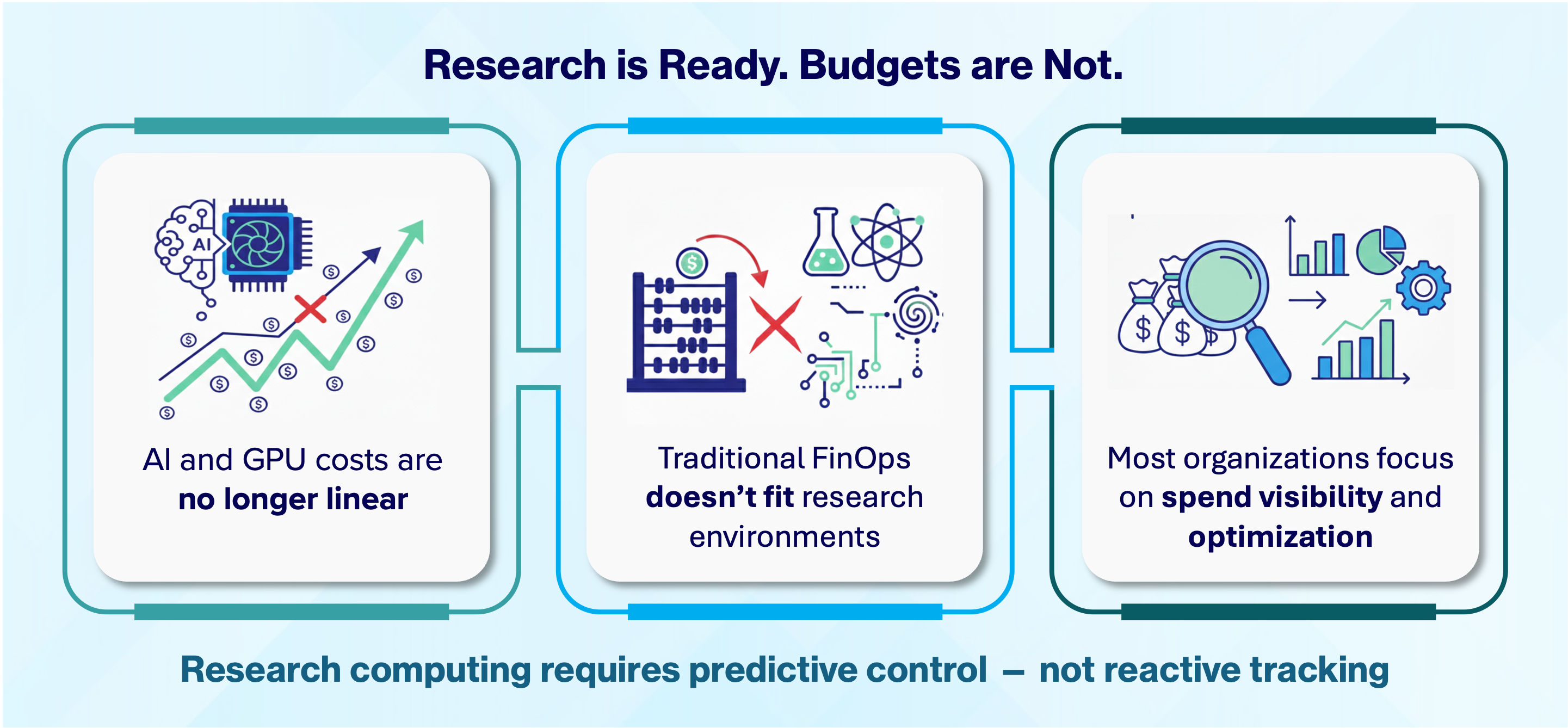
Instead, the next leap comes from goal-based GenAI agents that shifts FinOps from task execution to outcome optimization.
1. Research Computing in 2026: A Cost Problem Disguised as a Technology Problem
Research environments have undergone a fundamental phase change in how they provision and consume resources:
The New Cost Reality
Research workloads no longer follow predictable enterprise patterns. They are inherently:
- Non-linear, where one experiment can consume ten times the compute, storage, or GPU resources of another
- Exploratory, with no fixed end state, making upfront cost estimation difficult
- Shared, with clusters, GPUs, and datasets used across multiple teams and projects
- Cross-funded, spanning grants, departments, and research programs with distinct budget constraints
This variability makes traditional cost allocation and forecasting models insufficient for modern Research Computing environments.
As a result, FinOps teams struggle to answer critical questions:
- What will this experiment cost before it runs?
- Is this the most cost-effective path to achieve the research outcome?
- How should we balance accuracy, speed, and budget?
2. Why Traditional FinOps Breaks Down for Research Computing
FinOps, as practiced today, evolved for predictable enterprise workloads. Research Computing violates nearly every assumption behind it.
2.1 Cost Visibility Is Not Cost Intelligence
Most current FinOps implementations are retrospective. They rely on tools designed to audit history rather than influence the future:
- Spend Dashboards: Visualize past expenditures but offer no predictive foresight into active experiments.
- Cost Allocation: Tags resources after provisioning, which is often too late for high-velocity research.
- Alerts and Thresholds: Trigger notifications only when a ceiling is hit, not when a trajectory becomes inefficient
In research environments:
- Visibility comes after the experiment is done
- Alerts arrive after budgets are exceeded
- Optimization happens after money is already spent
This reactive posture is misaligned with exploratory science.
2.2 Organizational Silos Intensify the Challenge
Research FinOps sits at a high-friction intersection where three distinct groups optimize for conflicting KPIs:
- Finance Teams: Prioritize cost containment and budget predictability.
- IT/Ops Teams: Prioritize infrastructure stability, security, and governance.
- Researchers: Prioritize outcome velocity, accuracy, and time-to-discovery.
Without a unifying intelligence layer to reconcile these mandates, FinOps transitions from an accelerator into a blocking function. Finance tightens the belt, IT locks down the environment, and the researcher stuck in the middle loses the agility required for exploratory science.
2.3 GenAI Introduces a New Class of Financial Uncertainty
Generative AI workloads introduce financial complexities that standard cloud models simply weren't designed to handle:
- Variable Token Costs: Every prompt and response has a price tag that fluctuates based on model and context.
- Parameter Choices: Small changes in how a model is configured can cause huge swings in total spend.
- Non-Linear Pricing: The cost curves for training, fine-tuning, and inference (RAG) are all different and difficult to track manually.
The result is financial opacity at exactly the moment when leadership needs confidence to invest.
3. The Core Insight: Research Is Goal-Driven, Not Task-Driven
The disconnect in Research FinOps is fundamentally a mismatch in abstraction. We are trying to manage high-level scientific objectives using low-level administrative triggers.
How FinOps Works Today: Task-Based Automation
Most current automation is built on "if-then" logic. It focuses on discrete, binary tasks:
- Generate reports to show past spend.
- Enforce budgets by hard-capping resources.
- Stop idle resources based on static timers.
- Send alerts when a threshold is breached.
While these tasks are necessary for basic hygiene, they are context-blind. A script can turn off a GPU, but it doesn't know if that GPU was minutes away from completing a breakthrough simulation.
How Research Actually Works: Goal-Based Logic
Research does not follow a linear checklist; it moves toward a target. It is defined by high-level goals:
- Maximize Accuracy: Achieve the highest fidelity result possible within the limits of a specific grant.
- Meet Deadlines: Complete complex simulations before a conference or journal submission date.
- Iterate Efficiently: Explore multiple hypotheses in parallel by dynamically shifting compute power to the most promising paths.
The Shift to Agentic Intelligence
In Research Computing, success is never a single task. It is an optimized balance across time, cost, and quality.
This is where GenAI agents—rather than static scripts or dashboards—become essential. You need a system that understands the intent of the researcher and can make trade-off decisions in real-time to reach the goal without exceeding the budget.
4. From Task Automation to Goal-Based GenAI Agents
The transition from basic scripts to Goal-Based GenAI Agents marks a paradigm shift in how we manage Research Computing. Unlike traditional automation that simply follows a list of steps, an agent focuses on the final objective. It understands user intent, weighs complex trade-offs, and changes its actions in real-time to reach the goal.
The Sense → Plan → Act Model for Research FinOps
To balance strict financial control with the need for high-speed discovery, the agent operates in a continuous "Sense-Plan-Act" loop:
Sense: Gathering Context
The agent constantly monitors the research environment to stay aware of:
- Resource Usage: Current compute and GPU consumption levels.
- Market Dynamics: Real-time GPU availability and fluctuating cloud pricing.
- Efficiency Metrics: How specific models are performing relative to their cost.
- Governance: Grant budget limits, institutional policies, and compliance rules.
Plan: Reasoning and Trade-offs
Instead of following a rigid "if-then" script, the agent evaluates the best path forward:
- Hardware Selection: Deciding which instance types or GPUs (e.g., H100 vs. A100) actually fit the current workload.
- Purchasing Models: Determining if the job should run on Spot, Reserved, or On-Demand instances to save money.
- Optimization: Assessing if a smaller model or a different configuration can achieve the result for less.
- Forecasting: Projecting the total cost against the expected research outcome before spending starts.
Act: Dynamic Execution
The agent takes direct action to keep the project on track:
- Orchestration: Automatically provisioning or reconfiguring compute resources.
- Workload Shifting: Moving jobs between cloud regions or pricing models to capture savings.
- Smart Guardrails: Applying limits that protect the budget without completely stopping the researcher's work.
- Continuous Learning: Analyzing the results of its actions to improve its future plans and accuracy.
This model transforms FinOps from a static, "read-only" reporting tool into a dynamic decision engine that powers Research Computing.
5. How Goal-Based GenAI Agents Remove the FinOps Barrier
Adding a goal-based intelligence layer removes the innovation drag caused by traditional, reactive FinOps. It shifts FinOps from post-spend reporting and control to proactive, outcome-driven cost optimization, turning it into a strategic enabler of innovation.
Predictive Financial Control Instead of Reactive Enforcement
Instead of intervening after the budgets are exceeded, the Goal-based GenAI Agents enable proactive financial governance. It:
- Forecasts workload cost before execution
- Surface trade-offs across performance, accuracy, and spend
- Recommend optimized configurations, such as instance types, GPU classes, and pricing models
FinOps shifts from post-spend enforcement to real-time decision intelligence. It operates as an AI agent embedded directly in the research workflow.
Optimizing for Value, Not Just Cost
A goal-driven agent reframes optimization around research outcomes, rather than only reducing spend. It can determine:
- The best achievable result within a fixed grant or program budget
- Where additional compute investment produces diminishing returns
- How to balance speed, model accuracy, and financial constraints
This elevates FinOps from cost containment to measurable research ROI optimization.
Reduced Cognitive Load for Researchers
In elastic cloud HPC and GPU-intensive AI environments, cost modeling is inherently complex. Goal-based GenAI Agents absorb that complexity by:
- Interpreting cloud pricing structures and token-based GenAI costs
- Automating cost versus performance trade-off analysis
- Enforcing financial guardrails without interrupting experimentation
Researchers no longer need to navigate dashboards or manually justify each experiment. The system continuously optimizes cost against outcomes, allowing scientists to focus on discovery.
Why This Is a Vertical AI Problem — Not a Generic One
Research Computing is a vertical domain:
- Unique workloads
- Unique funding models
- Unique success metrics
Generic AI agents or horizontal FinOps tools lack:
- Research context
- Domain-specific optimization logic
- Understanding of scientific workflows
Goal-based GenAI agents are most effective when deeply embedded in these vertical realities. They must understand the relationship between compute configuration, model performance, budget limits, and research objectives.
This is why FinOps for Research cannot be solved with generic automation. It requires domain-aware intelligence.
The 2026 Outlook: FinOps as an Enabler, Not a Barrier
By 2026, the organizations that lead in Research Computing will not be those that simply minimize cloud spend or impose the strictest budget controls. In an environment defined by elastic HPC, GPU-intensive AI workloads, and token-based GenAI pricing, cost suppression alone does not create competitive advantage.
Leaders will be those that:
- Optimize compute, model configuration, and pricing models intelligently
- Forecast financial impact before workloads are executed
- Align infrastructure spend directly with research outcomes, grant objectives, and performance targets
Goal-based GenAI agents represent the missing layer that reconciles innovation and financial discipline. By embedding predictive cost modeling and outcome-driven optimization into the research workflow, they reconcile innovation with financial discipline, transforming FinOps from a constraint into a strategic enabler of scalable Research Computing.
Relevance Lab Perspective
At Relevance Lab, we believe:
“FinOps is no longer a reporting problem.
It is a decision-making problem, and GenAI agents provide the right abstraction to solve it.”
By shifting from task-based automation to goal-based intelligence, Research Computing can scale without fear of cost chaos.
Ready to Explore Research-Aware FinOps? Let’s talk and reimagine FinOps not as a barrier, but as a strategic accelerator for research innovation.