

Introduction: Why ISVs Must Rethink Their GenAI Strategy
Independent Software Vendors (ISVs) currently stand at a pivotal strategic juncture. The emergence of Generative AI (GenAI) brings a major opportunity to deliver new value, but many organizations are still deciding how to move forward.
Today, most enterprise SaaS platforms are designed as systems of record—they are excellent at collecting transactional data, showing dashboards, and sending out alerts. However, they leave it up to users to interpret the information and decide what comes next.
This creates challenges. Users have to deal with complicated dashboards, manage multiple alerts, and figure out what actions to take. The result is often “dashboard fatigue,” constant alert noise, and slow decision-making.
In response, many ISVs have added chatbots, AI-powered search, or auto-generated content. While these enhancements provide incremental benefits, they rarely deliver lasting differentiation or meaningful decision support.
Through our product engineering work at Relevance Lab, we identified a different approach. We asked a fundamental question: How can GenAI serve as a complementary intelligence layer—making existing SaaS platforms smarter without disrupting trusted workflows or core systems?
This article outlines the high-value GenAI use cases we validated, how they form a scalable intelligence roadmap, and how this pattern applies across multiple ISV verticals.
The Strategic Case for a Complementary Intelligence Layer
Replacing core SaaS workflows with GenAI is a high-risk and often unnecessary approach. It disrupts established user behavior, introduces significant engineering complexity, and creates adoption friction—especially in regulated or mission-critical environments.
A more strategic approach involves building a complementary GenAI intelligence layer:
- Sits above existing transactional systems
- Reasons across siloed data
- Explains context and impact
- Guides decisions instead of adding more dashboards
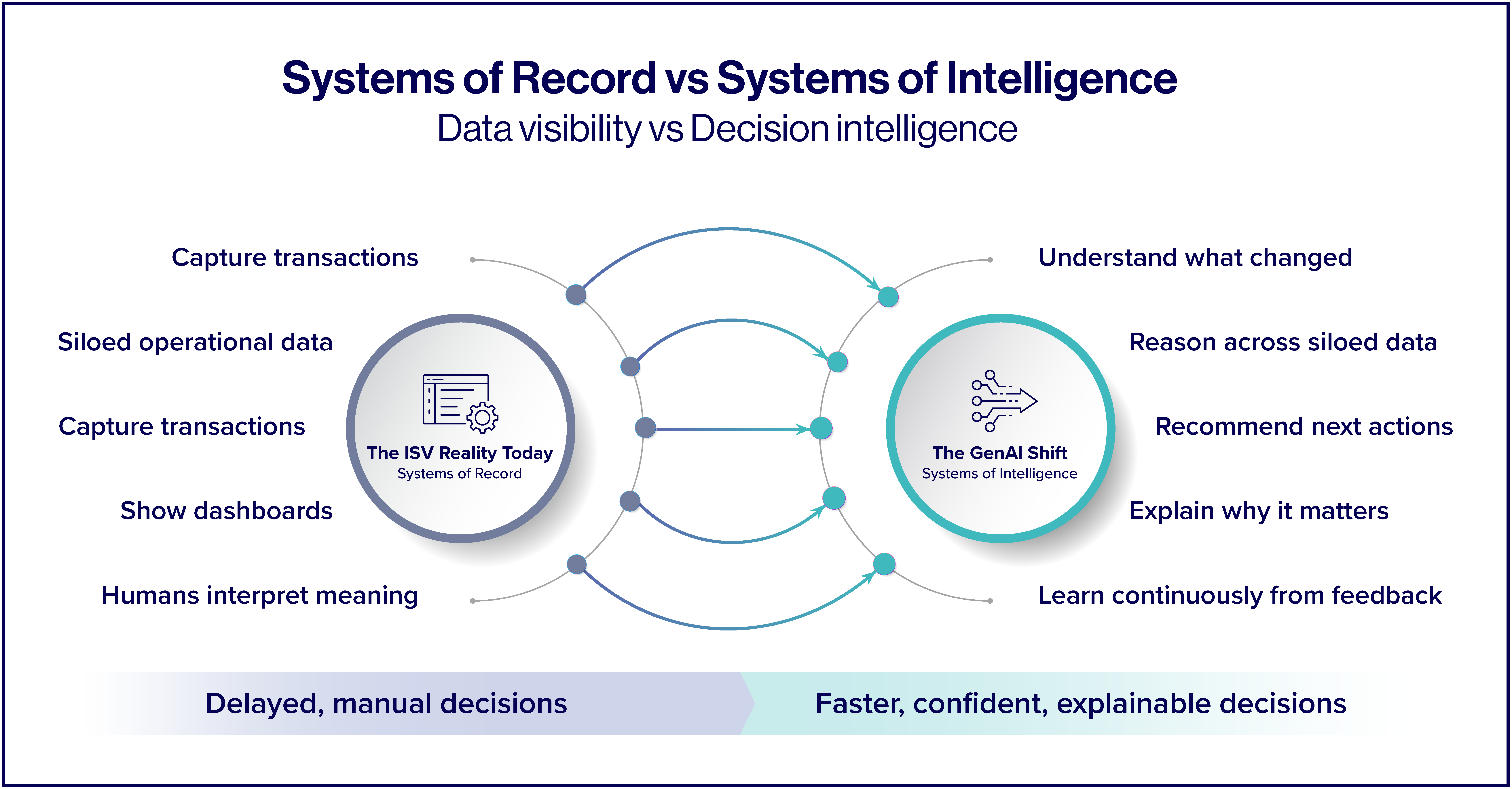
This architectural approach enables ISVs to achieve three critical objectives:
- Preserve Trust and Compliance: Core transactional logic remains unchanged, maintaining existing compliance and control frameworks.
- Minimize Engineering Disruption: Teams avoid rewriting foundational systems while still delivering meaningful intelligence.
- Introduce Premium, AI-driven Value: AI-driven insights unlock higher-value product tiers and deeper customer engagement.
The Intelligence Pattern: From Transactions to Decisions
Across the ISV landscape, a consistent capability gap exists. Software is effective at displaying data—but often fails to explain what it means or guide the next best action.
To close this gap, we established a reusable intelligence pattern built around a closed-loop system:
Sense → Detect → Decide → Act → Learn.
Every GenAI capability—current or future—must align to this loop. This ensures the platform evolves as a learning system, rather than a collection of disconnected AI features.
_V2.png)
Phase 1: Validating High-Value GenAI Use Cases
Our journey began by validating three specific use cases that map directly to the intelligence loop. These serve as the foundation for a smarter platform.
1. Daily Summary Generation (The "Sense" Function)
The Problem: Users are overwhelmed by dense dashboards and often miss critical updates.
The GenAI Capability: An intelligent agent synthesizes activity across disparate systems, highlighting material changes and explaining why they matter in clear, role-specific business language.
The Strategic Outcome: This reduces dashboard fatigue and provides faster situational awareness, allowing users to start their day with clarity.
2. Anomaly WatchDog (The "Detect" Function)
The Problem: Traditional alerts are threshold-based and context-blind, resulting in high noise and low trust.
The GenAI Capability: The system detects contextual anomalies across domains and explains why they are significant. User feedback is captured to continuously reduce false positives.
The Strategic Outcome: Users gain higher trust in their alert systems, leading to earlier detection of legitimate risks and inefficiencies.
3. Product and Action Recommender (The "Decide" Function)
The Problem: Users struggle to select the right product, configuration, or corrective action amid complex constraints.
The GenAI Capability: The engine understands user intent, evaluates cost, policy, and risk factors, and recommends the best-fit action with a clear, explainable rationale.
The Strategic Outcome: Decisions are accelerated, and reliance on deep subject matter expertise is reduced.
Beyond the First Three: Expanding the GenAI Roadmap
Once the intelligence layer is established, additional use cases emerge naturally, extending the platform's value.
4. Root Cause & Impact Analysis
This capability correlates events, configuration changes, and usage patterns to explain why an issue occurred. It quantifies the blast radius of the event, allowing teams to understand the full business impact immediately.
5. Continuous Optimization & Auto-Remediation
The system evolves from passive analysis to active proposal. It suggests corrective actions, simulates potential savings and impacts, and executes changes with human-in-the-loop approvals.
6. Natural Language Control Plane
This transforms the user interface. It allows users to operate the platform using intent-based commands, simplifying complex workflows and reducing training requirements.
7. Predictive & Proactive Intelligence
Moving from reactive to proactive, this capability anticipates risks before thresholds are breached. It warns users early and suggests preventive actions to avert incidents entirely.
Vertical-Specific GenAI Use Cases for ISVs
While the GenAI intelligence layer is designed to be horizontal and reusable, its true value is realized when applied to vertical-specific workflows and decisions.
The same intelligence capabilities adapt through context—driving distinct outcomes across industries.

Design Principles Behind the Platform
To ensure this platform remains robust and trustworthy, we adhere to four immutable design principles:
- LLMs Reason, Systems Decide: We use Large Language Models (LLMs) for their reasoning capabilities, but final decisions and executions are governed by deterministic system logic.
- Augment, Do Not Replace: GenAI enhances core workflows; it does not attempt to replace the fundamental business logic that users rely on.
- Horizontal First, Vertical via Context: We build the intelligence engine as a horizontal capability, applying vertical specificity through context injection.
- Feedback is a Product Capability: User feedback loops are not an afterthought; they are central to the product's ability to learn and improve.
Conclusion: The Shift to Systems of Intelligence
For ISVs, the path forward is clear. The goal is to evolve from providing systems of record to delivering systems of intelligence.
By adopting this complementary approach, ISVs can introduce premium, AI-driven experiences that increase customer stickiness and differentiate their offerings beyond generic "AI-powered" marketing claims.
The organizations that will dominate their respective markets are those that focus on decision intelligence. They will build closed-loop systems that learn continuously and treat GenAI as a core platform capability rather than a feature. This is how GenAI transforms from a buzzword into a long-term competitive advantage.