

Introduction
In the fast-evolving world of software engineering, the demand for speed, precision, and continuous improvement has never been greater. To address these challenges, Relevance Lab introduces the Fantastic Four GenAI SDLC Agents, designed to operationalize AI Pods and revolutionize the software development lifecycle.
Meet the Fantastic Four:
- GenAI Smart Code Assessment Agent
- GenAI Code Remediation Agent
- GenAI Test Automation & Coverage Agent
- GenAI Support Tickets → Feature Generation Agent
Together, these agents form a closed-loop intelligent engineering system: Assess → Remediate → Test → Improve → Repeat. By harnessing advanced AI capabilities, they empower teams to:
- Gain real-time insights into engineering health.
- Automate the remediation of code issues.
- Achieve higher test coverage and reliability with AI-driven testing.
- Close the feedback loop between production and engineering.
Meet the Four GenAI SDLC Agents
These agents are purpose-built to align with the lifecycle stages of modern software engineering.
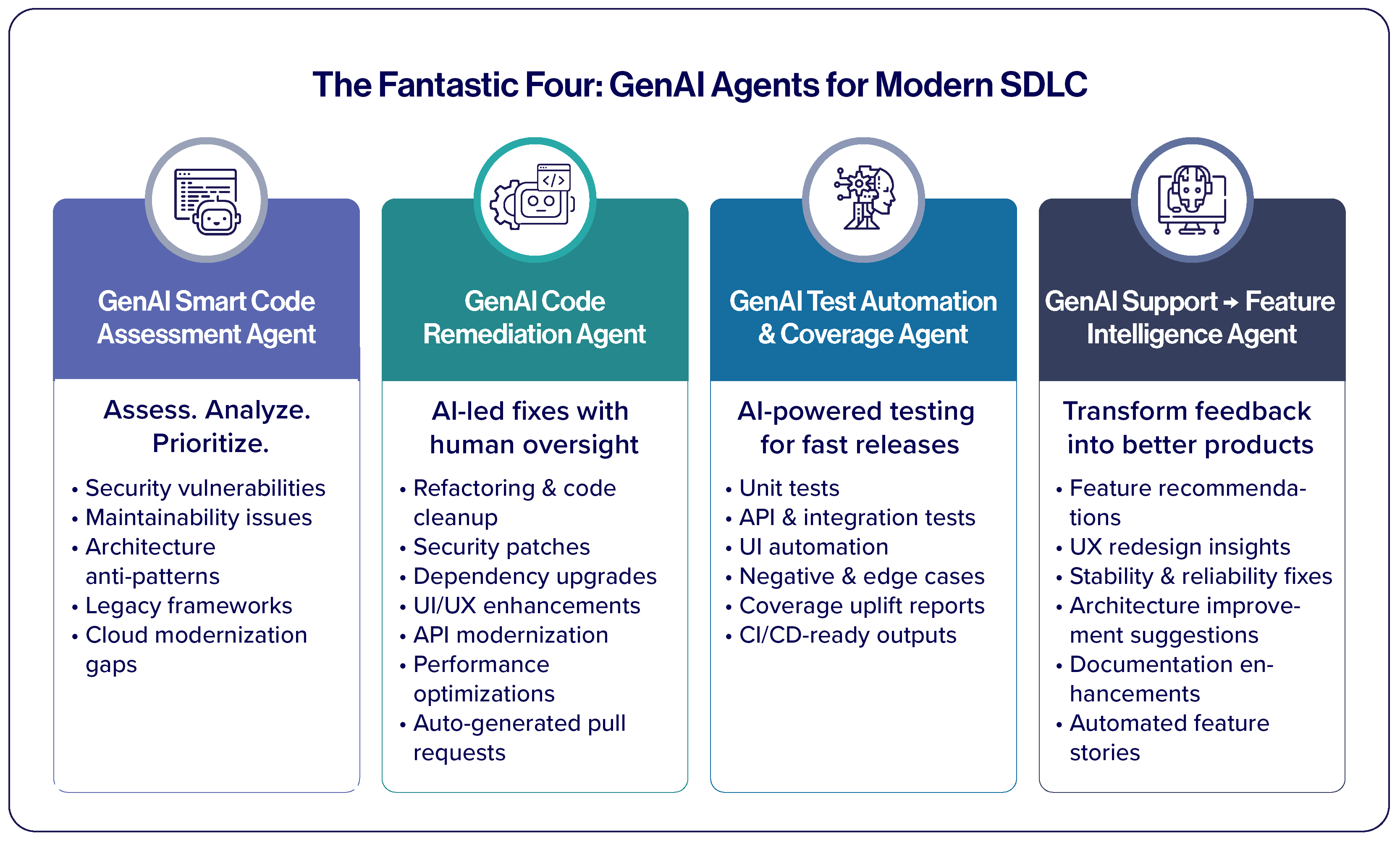
1. GenAI Smart Code Assessment Agent
The intelligence engine for code, architecture, and modernization gaps.
This agent provides real-time insights into code quality and architecture, helping teams identify and prioritize improvements.
Key Capabilities:
- Large-scale repository scanning
- Architecture pattern recognition
- DevSecOps vulnerability mapping
- Cloud readiness evaluation
- Technical debt scoring
- Auto-generated assessment reports
- Backlog creation for SAFe PI Planning
Impact:
With a real-time engineering health dashboard, Product and Architecture leaders gain the clarity needed to drive informed decisions.
2. GenAI Code Remediation Agent
Auto-fixes issues discovered by the Assessment Agent.
This agent transforms the findings of the Assessment Agent into actionable solutions, automating complex remediation tasks.
Key Capabilities:
- Code smells and refactoring
- UI/UX cleanup
- Security patching
- Dependency upgrades
- API modernization
- Performance tuning
- Automated pull request generation
Impact:
What once took weeks can now be accomplished in hours, enabling teams to focus on innovation.
3. GenAI Test Automation & Coverage Agent
Transforms testing into a fully AI-first discipline.
This agent elevates testing to a new level of efficiency and reliability, ensuring comprehensive coverage.
Key Capabilities:
- Unit, API, UI, and integration test generation
- Test gap detection
- Automated regression suite creation
- Test prioritization based on risk
- Code coverage improvement
- CI/CD integration
Impact:
With 80–90% automation coverage, teams can achieve reliable results with minimal manual effort.
4. GenAI Support Tickets to Feature Generation Agent
Connects production reality back into product engineering.
This agent closes the loop between customer experience and product development by turning support insights into actionable engineering tasks.
Key Capabilities:
- Identifies recurring support issues
- Clusters root causes
- Suggests UX fixes, refactoring needs, architecture changes
- Generates feature stories
- Improves product stability
- Reduces operational overhead
Impact:
By connecting production reality back to engineering, this agent ensures continuous improvement and customer satisfaction.
How the 4 GenAI SDLC Agents Solve Real Engineering Challenges
Let’s explore how the Fantastic Four GenAI SDLC Agents work together to address a recurring SaaS product issue:
The Problem: Users report that “search results are slow or missing items.”
This complaint appears repeatedly across support tickets, error logs, and user feedback channels. The GenAI SDLC Agents collaborate as a closed-loop system to detect, resolve, test, and validate the solution, ensuring the issue is permanently addressed.
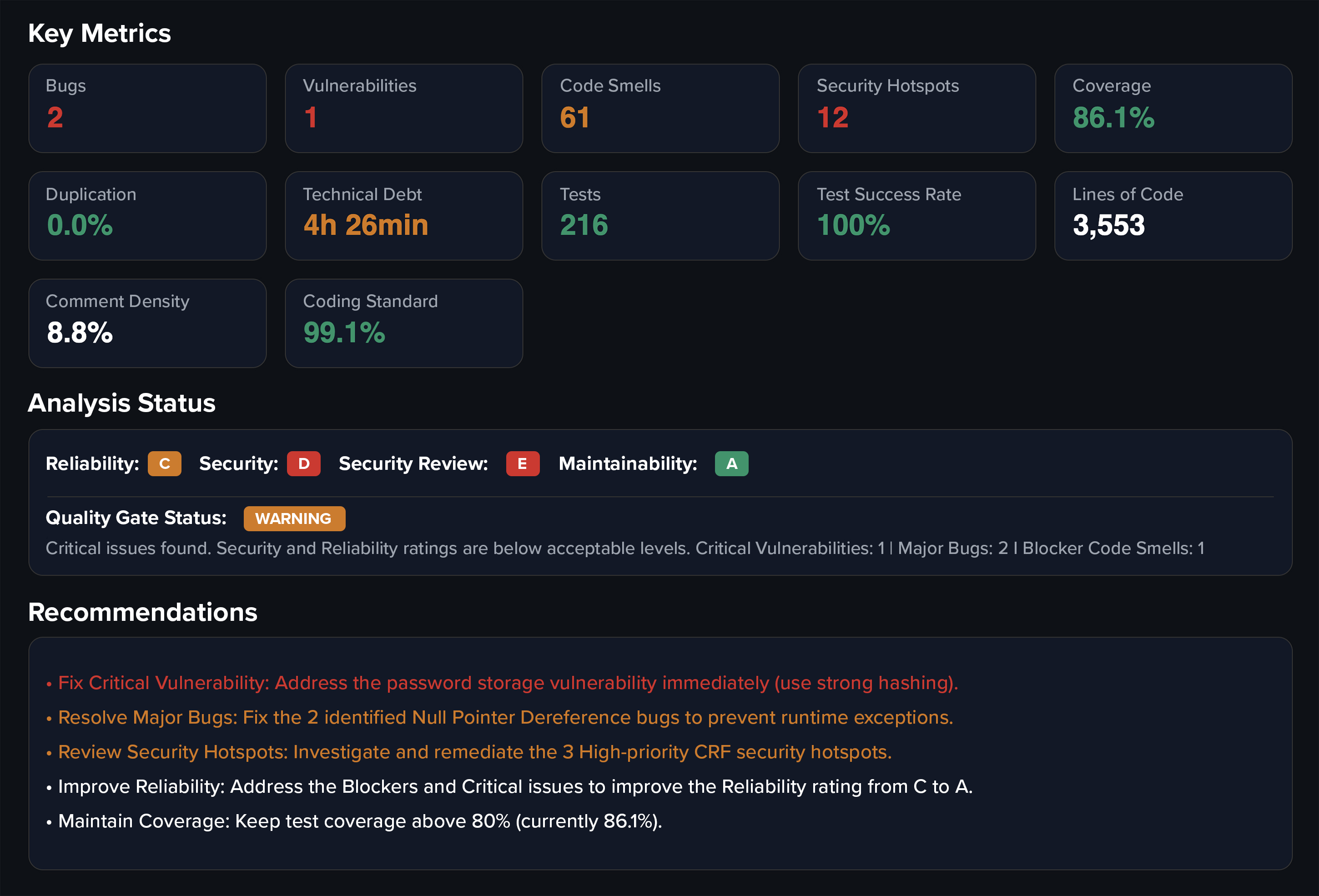
1. Smart Code Assessment Agent — Maps the Fix
The agent scans the codebase and finds:
- Legacy query functions causing inefficiencies.
- Unused indexes in search queries.
- Inefficient pagination logic.
- A large, unmaintainable search handler.
- Opportunities for caching and ranking improvements.
The agent delivers:
- A code modernization report outlining the issues.
- Recommended architectural improvements for scalability.
- A prioritized technical task list to guide remediation efforts.
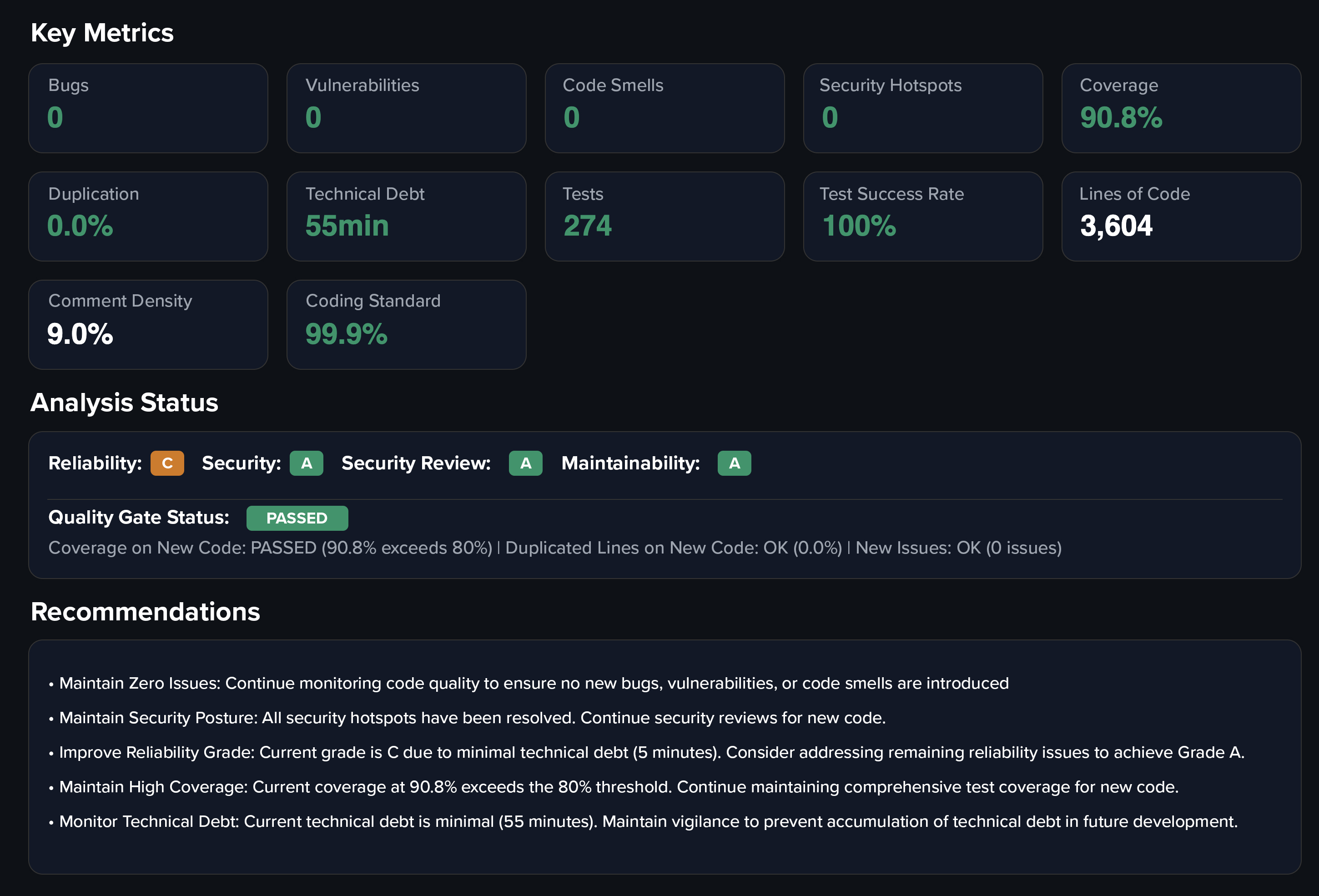
2. Code Remediation Agent — Generates the Fix
The agent generates draft Pull Requests that include:
- Updated search queries utilizing the correct indexes.
- An improved ranking algorithm for better results.
- Optimized pagination logic for faster performance.
- A caching layer to handle repeated searches efficiently.
- Refactored large methods into smaller, maintainable components.
Each PR is accompanied by:
- Detailed explanations of the changes.
- Rollback steps for safety.
- Performance improvement notes for transparency.
Engineers review, refine, and approve the PRs for deployment.
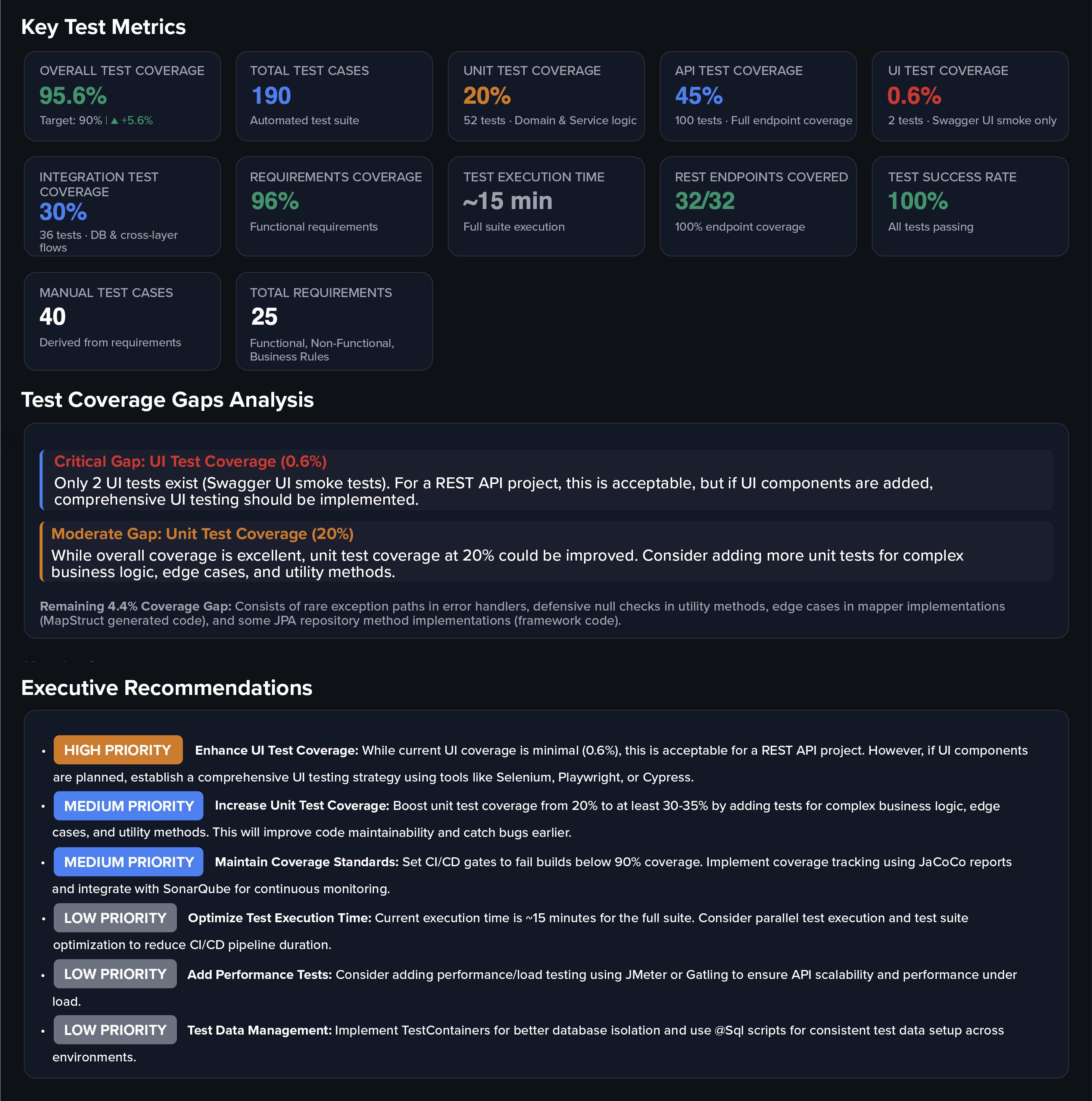
3. Test Automation & Coverage Agent — Validates the Fix
The agent ensures the solution is robust and reliable by auto-generating:
- Unit tests for the ranking logic.
- Integration tests for the search API.
- UI automation tests for the search flow.
- Performance benchmarks to validate speed improvements.
- Regression tests to ensure legacy functionality remains intact.
These tests are executed in the CI/CD pipeline, guaranteeing quality and safety before deployment.
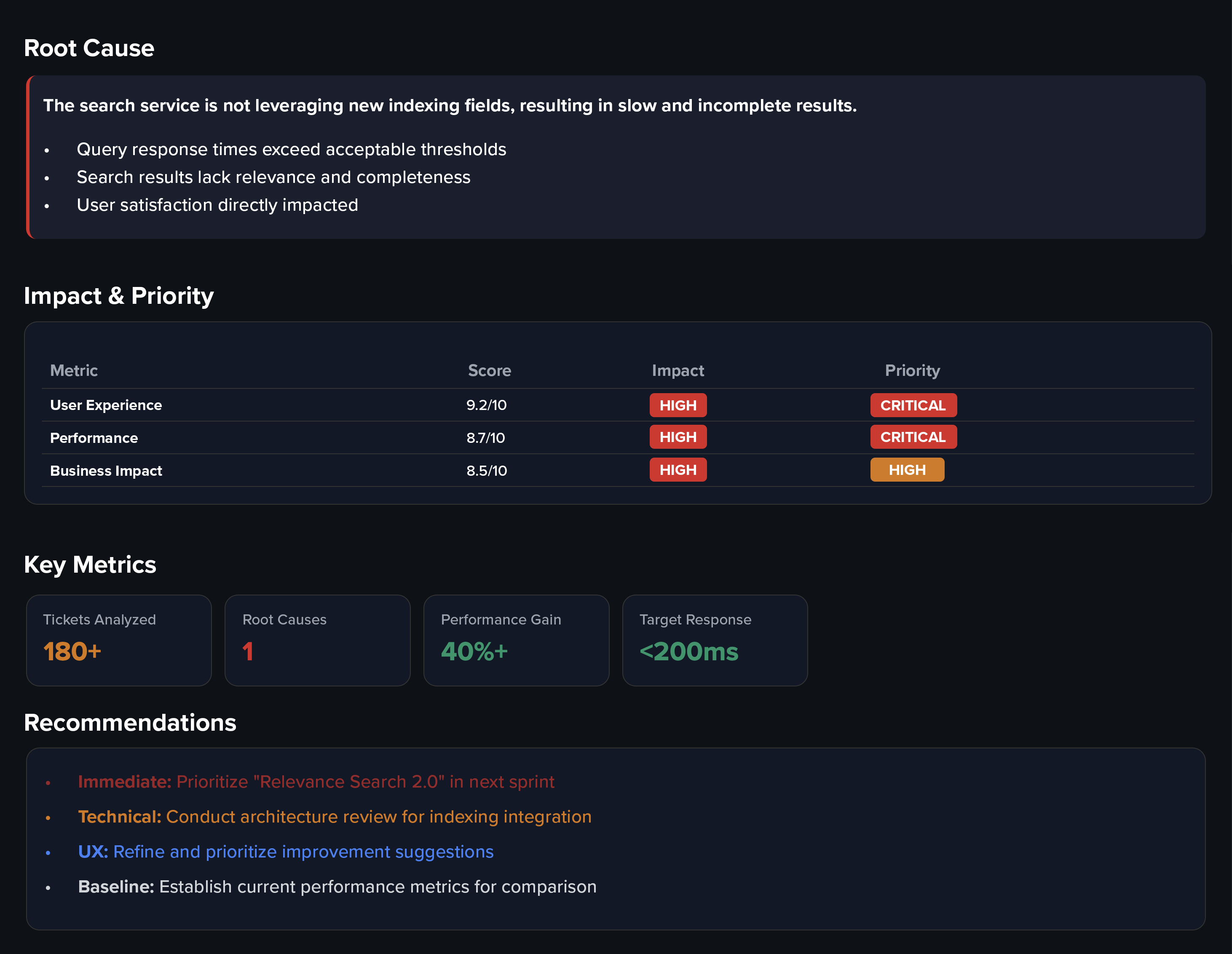
4. Support → Feature Intelligence Agent — Detects the Problem
The agent analyzes:
- 180+ support tickets for recurring patterns.
- Error logs showing long-running queries.
- User feedback highlighting search accuracy issues.
Using AI clustering, the agent pinpoints the root cause:
- The search service is not leveraging new indexing fields, resulting in slow and incomplete results.
The agent generates actionable outputs:
- A feature story (“Relevance Search 2.0”) with acceptance criteria.
- UX improvement suggestions to enhance user experience.
- Impact and priority scoring to guide engineering focus.
This becomes a ready-to-execute backlog item for the engineering team.
Closed Loop Outcomes
After the fix is deployed, the results speak for themselves:
- 72% reduction in search-related support tickets.
- Search latency drops from 1200ms to 250ms.
- Search result accuracy improves significantly.
- Customer satisfaction scores see a noticeable boost.
The system continuously learns from these outcomes, feeding insights back into future improvements, ensuring a cycle of continuous enhancement.
One Closed Loop, Four Agents, Continuous Improvement
The Fantastic Four GenAI SDLC Agents are revolutionizing software engineering by creating a seamless, intelligent, and automated development lifecycle.
Support → Assessment → Remediation → Testing → Release → Learning
This is the power of the GenAI SDLC Agent Suite—turning real-world product pain into automated, high-quality engineering outcomes at scale.
Ready to harness the power of the Fantastic Four GenAI SDLC Agents? Let’s connect and explore how these agents can transform your software engineering lifecycle and help you achieve speed, precision, and impact at scale.