

Enterprise analytics has made significant progress over the last decade.
Data platforms are faster, more scalable, and more reliable than ever before.
Yet, the experience of building analytics assets has not improved at the same pace, especially for data engineers working in complex, multi-system environments.
At Relevance Lab, we see this challenge repeatedly across engagements. And the root cause is rarely the platform. It is the absence of context.
The Daily Reality for Data Engineering Teams
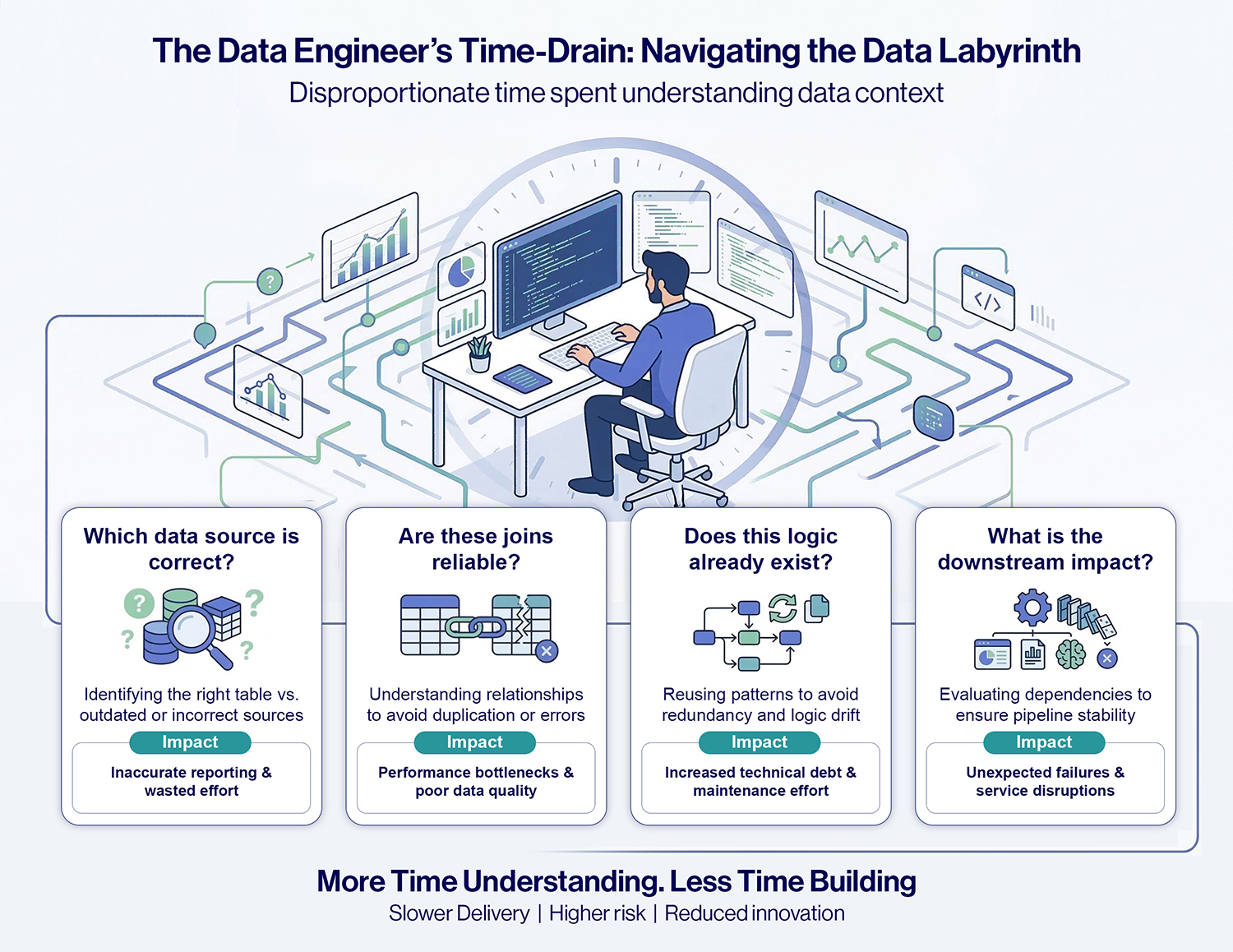
In most organizations, data engineers spend a disproportionate amount of time answering questions like:
- Which tables should be used for this metric?
- What joins are valid - and which are risky?
- How has similar logic been implemented elsewhere?
- What downstream assets will this change affect?
These questions rarely have clear, documented answers.
Instead, they are resolved through experience, trial and error, and tribal knowledge.
As data landscapes grow, this implicit understanding becomes harder to maintain. As a result:
- New engineers take longer to onboard – taking at least 2-3 weeks in large organizations just to understand the context and identify the relevant tables.
- Changes become riskier
- Analytics delivery slows
From our work with large, multi-ERP organizations, it is clear that this is not a tooling gap, it is a context gap.
Why Traditional Approaches Don’t Scale
EOver time, enterprises have tried to address this problem through:
- Standardized schemas
- Semantic layers
- Documentation initiatives
- Reusable SQL patterns
While helpful, these approaches depend heavily on manual upkeep. In environments with hundreds or thousands of tables, they struggle to stay current.
As a result, engineers repeatedly reconstruct the same understanding, often under time pressure, before writing even a single line of SQL. This manual reconstruction is also what limits the effectiveness of AI-assisted analytics today.

Where AI Falls Short Without Context
Large language models have made it possible to generate SQL and answer questions in natural language. However, in enterprise environments, correctness matters more than convenience.
Without an explicit understanding of how data is connected, AI systems are forced to infer relationships from schemas or descriptions alone. This leads to ambiguity, inconsistent results, and a lack of trust.
At Relevance Lab, we’ve observed a growing shift in how organizations think about analytics enablement.
Instead of asking how to generate queries faster, leading teams are asking:
How do we make our data understandable, to both humans and AI, by default?
This shift has led to increased interest in GraphRAG-based approaches, where AI reasoning is grounded in an explicit representation of entities and their relationships.
GraphRAG introduces structure into retrieval and reasoning, enabling AI systems to operate with awareness of how data is connected, not just how it is described.
.png)
A Shift in How Analytics Assets Are Designed
When relationships and business meaning are explicitly modeled, the role of data engineers changes in subtle but important ways.
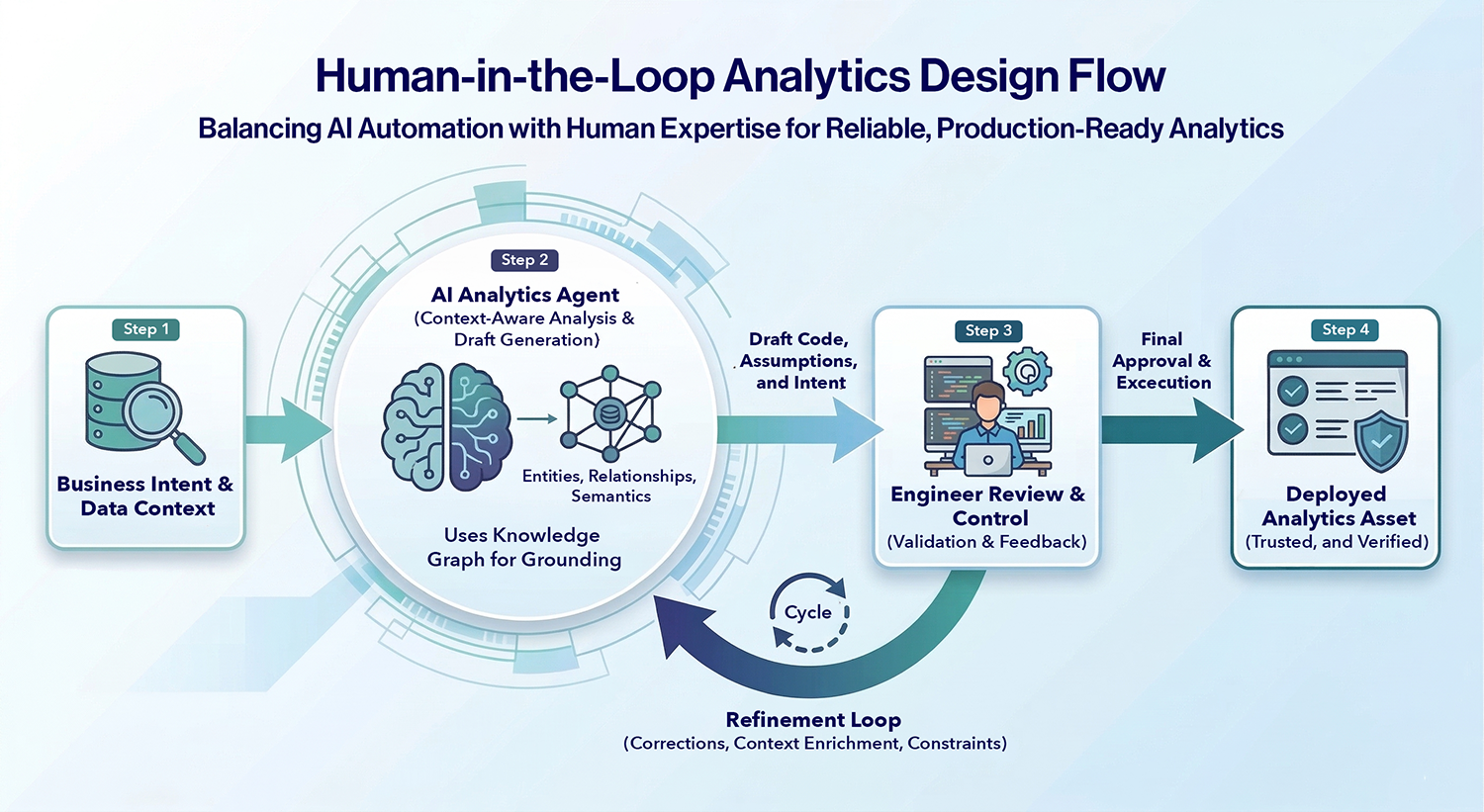
Instead of starting with tables and joins, engineers can start with intent. They can specify:
- The outcomes they need
- The columns or measures involved
- The business entities in scope
From there, a context-aware analytics agent can surface:
- Multiple valid design options
- Trade-offs between different approaches
- Potential downstream impact
- Recommendations aligned with existing patterns
The engineer remains responsible for decisions and approvals, but no longer has to rediscover context from scratch. This accelerates development while improving consistency.
Designed for Control, not merely Automation
A critical requirement in enterprise data environments is governance.
Any intelligent analytics system must be:
- Explainable
- Auditable
- Predictable
This is why context-aware analytics agents are designed with human-in-the-loop workflows. Before execution, intent is validated, assumptions are surfaced, and engineers retain final control.
The data platform continues to execute queries.
The semantic layer provides understanding.
Secondary Impact: Better Business Interaction
While data engineers are the primary beneficiaries, making context explicit also improves how business users interact with analytics.
Because relationships and meaning are already modeled, natural language queries can be interpreted more reliably. Instead of guessing joins, the system reasons over known connections.
This reduces back-and-forth, improves trust in results, and allows data teams to focus on higher-value work.
Importantly, this does not require exposing business users to the underlying complexity.
Why This Approach Is Practical Now
The idea of combining graphs and analytics is not new. The use of knowledge graphs for unstructured data has been proven across multiple use cases.
In large enterprises with hundreds of data assets and thousands of underlying tables, building a knowledge graph from structured data has historically been infeasible due to the sheer manual effort involved. What has changed is feasibility, automation and intelligent reasoning now make this approach practical at enterprise scale.
Recent advances have made it possible to:
- Infer context automatically from existing pipelines
- Use GraphRAG patterns to guide AI reasoning
- Apply agent-based workflows with clear guardrails
Together, these shifts enable a new analytics layer, one that fits alongside existing platforms without disruption.
Relevance Lab can accelerate enterprise adoption of knowledge-graph-driven analytics. Through automated, scalable construction and continuous updates of knowledge graphs from structured data, we can enable data engineers to build and modify assets efficiently, making delivery faster and reducing risk.
.png)
A Quiet but Meaningful Evolution
This approach does not introduce a new data platform.
It does not replace SQL or existing BI tools.
It adds something that most stacks are missing: a persistent, navigable understanding of how enterprise data works.
For data engineers, this means less time decoding and more time designing.
For organizations, it means analytics that can finally scale with complexity.
As enterprise data ecosystems continue to grow, this shift from schema-driven analytics to context-aware reasoning will quietly become a necessity.