

Introduction
As digital ecosystems continue to expand, enterprises are facing unprecedented complexity in managing IT operations. Traditional AIOps and Site Reliability Engineering (SRE) models have delivered significant gains in automation, observability, and incident response. However, with the emergence of Generative AI (GenAI), organizations now have the opportunity to elevate their operations from reactive and rule-based to predictive, conversational, and intent-driven.
For AIOps specialists, integrating GenAI is not about adding AI as a layer on top. It is about reimagining the way operations, monitoring, and reliability are managed through an intelligence-driven architecture that can reason, explain, and act.
The Need for Evolution
AIOps today integrates service management, automation, and monitoring using standard tools and frameworks. Yet, many functions still rely on human judgment, manual correlation, and static playbooks. This creates bottlenecks in scaling operational efficiency and reducing mean time to resolution (MTTR).
GenAI changes this dynamic by enabling contextual understanding, natural language reasoning, and automated decision-making. By embedding GenAI into AIOps and SRE processes, organizations can accelerate resolution times, reduce toil, and achieve proactive reliability.
The GenAI-Enhanced AIOps Evolution Framework
Phase 1: Anchor on Value
Begin by mapping the existing AIOps value chain across Service Management, Automation, and Monitoring. Identify where human bottlenecks exist, such as ticket triage, alert noise management, or root cause analysis.
Next, prioritize the GenAI insertion points:
- Service Management: AI-driven ticket summarization, prioritization, and sentiment extraction.
- Automation: Natural language to automation scripts and dynamic runbook creation.
- Monitoring: Narrative generation for anomalies, probable cause identification, and AI-assisted remediation suggestions.
Phase 2: Design the GenAI Layer
Adopt a layered architectural approach:
- Data Foundation: Aggregate logs, events, metrics, and tickets into a unified vectorized knowledge base.
- Model Layer: Utilize domain-tuned large language models (LLMs) optimized for IT operations vocabulary.
- Agent Layer: Deploy task-specific AI agents such as Incident Triage, Root Cause Analysis, and Automation Suggester.
- Integration Layer: Connect these AI agents seamlessly with existing AIOps platforms like ServiceNow, Jira, Prometheus, Elastic, or Ansible.
Phase 3: Start with High-ROI Use Cases
Phase 4: Build Feedback Loops
- Keep a human-in-the-loop for high-risk decisions.
- Continuously learn from resolved incidents to enhance AI accuracy.
- Implement governance controls for auditability, explainability, and AI-driven actions.
Phase 5: Scale and Automate
Once stable, expand AI from a co-pilot to an autonomous operator for predictable incidents. Move toward predictive AIOps where GenAI anticipates failures before they occur and recommends proactive remediations.
Real-World Examples
- ServiceNow + GenAI: Now Assist uses LLMs for ticket summarization and automated workflows, reducing incident handling time by 40%.
- Dynatrace Davis AI: Combines deterministic AI for RCA with natural language explanations and contextual auto-remediation.
- IBM Watson AIOps: Deduplicates alerts, enriches context, and suggests probable causes with ready-to-execute remediation scripts, reducing MTTR by 60% in telecom environments.
- Atlassian Intelligence: Integrates GenAI for service request classification, knowledge lookup, and chatbot-based resolution.
- Elastic AI Assistant: Translates raw observability data into human-readable insights, enabling non-experts to act confidently.
Extending the SRE Paradigm with GenAI for Smarter, Proactive Operations
Extending the Site Reliability Engineering (SRE) paradigm for AIOps with GenAI means enhancing core SRE principles with LLM-driven intelligence to create more proactive, adaptive, and human-friendly operations. GenAI augments incident analysis, automates routine decision-making, and provides natural-language interfaces for troubleshooting and runbook execution, all while preserving the rigor and reliability discipline that SRE demands. This evolution enables teams to shift from manual, tool-centric workflows to intent-driven reliability management that scales more efficiently and reduces cognitive load on engineers.
GenAI-Extended SRE Operating Model
The integration of GenAI within the SRE paradigm allows teams to move beyond static playbooks and manual interventions. It transforms how incidents are detected, managed, and resolved.
- Incident Management and Response
- Real-time incident summarization and context updates.
- AI triage agents that classify incidents based on historical patterns.
- Auto-suggested remediation actions drawn from previous resolutions.
- AI-driven “Situation Room” that maintains a shared narrative timeline for all responders.
- Root Cause Analysis (RCA)
- Automated reasoning over logs and metrics to surface anomalies.
- Hypothesis generation and testing based on dependency graphs.
- Auto-generated postmortem drafts with incident timelines and contributing factors.
- Reliability Engineering and Error Budgets
- Predictive modeling to forecast error budget consumption.
- Automated throttling or failovers to prevent SLO breaches.
- Narrative reliability reports for business and engineering teams.
- Toil Reduction
- Convert plain English instructions into automation scripts.
- Self-healing systems for recurring issues.
- Conversational search across configurations, runbooks, and documentation.
- Continuous Learning and Improvement
- Pattern mining to detect recurring reliability issues.
- Conversational “Ops Mentor” that trains SREs through real-time guidance.
- AI-augmented chaos engineering experiments for resilience validation.
Prescriptive Adoption Path for SRE + GenAI
1. Start with Augmentation, Not Replacement – Introduce GenAI as a co-pilot for low-risk, high-volume activities such as alert triage, noise reduction, and drafting operational reports.
2. Integrate into the SRE Toolchain – Embed GenAI across your existing monitoring, CI/CD pipelines, incident management systems, and observability platforms to enhance current workflows.
3. Implement Governance and Guardrails – Define clear standards for auditability, explainability, and approval workflows to ensure safe and controlled AI-driven actions.
4. Continuously Close the Feedback Loop – Feed resolved incidents and postmortem insights back into GenAI models to refine accuracy and strengthen future responses.
Maturity Model: From Traditional to GenAI-Driven Reliability
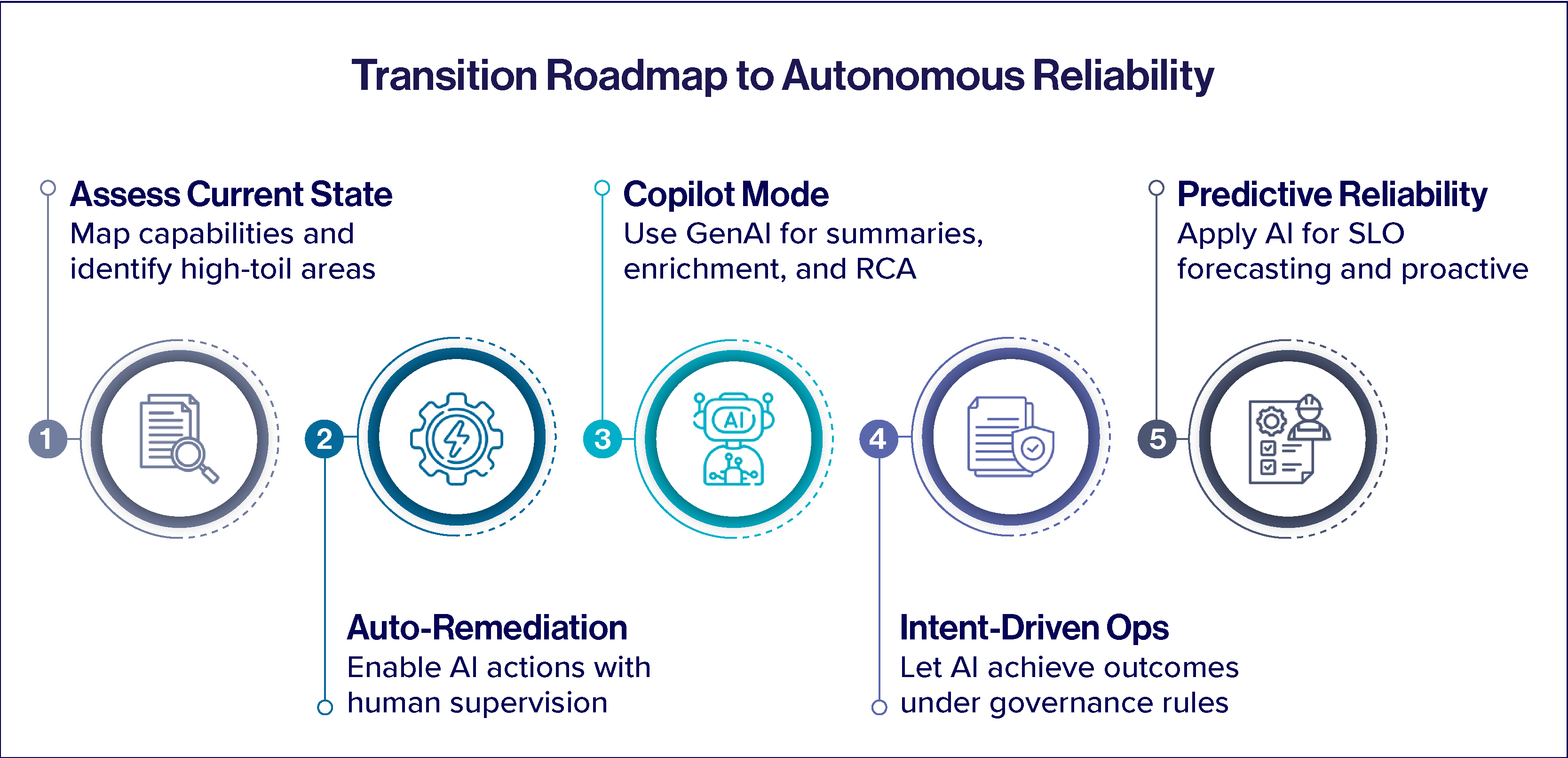
Transition Roadmap
- Assess Current State: Map existing capabilities to the maturity model. Identify areas with high toil or cognitive load.
- Begin with Co-Pilot Mode: Introduce GenAI for summarization, enrichment, and RCA assistance.
- Expand to Predictive Reliability: Use AI for SLO forecasting and proactive remediation.
- Enable Controlled Auto-Remediation: Implement AI-triggered actions under human supervision.
- Move to Intent-Driven Operations: Define desired outcomes, allowing AI to determine optimal paths under governance rules.
Conclusion
By embedding GenAI within AIOps and SRE, enterprises can transition from reactive operations to a proactive, predictive, and autonomous reliability model. This evolution enables faster resolution, reduced operational overhead, and a more resilient digital environment. For AIOps specialists, the opportunity lies in turning operational intelligence into adaptive systems that continuously learn, improve, and optimize—creating the foundation for the next generation of intelligent operations.