

Introduction
Scientific Computing and Engineering Design teams across industries are under pressure to deliver faster innovation while managing increasingly complex software stacks, compliance requirements, and infrastructure constraints.
Traditional workstation-based setups struggle to keep up. Scaling is slow, onboarding is manual, and secure collaboration across distributed teams becomes increasingly difficult.
To address this, we implemented a pre-built, cloud-native solution using AWS Research and Engineering Studio (RES), which enables engineers and researchers to securely access specialized scientific and engineering software in the cloud—without requiring deep cloud expertise.
The solution works seamlessly across Amazon Web Services Commercial and AWS GovCloud, making it suitable for both innovation-driven and compliance-sensitive environments.
This blog outlines a repeatable, frictionless blueprint for modern Scientific Computing and Engineering Design workloads.
The Challenge: Scaling Scientific & Engineering Workloads
Organizations running advanced Scientific Computing and Engineering Design workloads commonly face:
- Performance limits of physical workstations
- Complex installation and license management for specialized tools
- Slow onboarding of engineers and researchers
- Limited remote access and collaboration
- Compliance constraints that slow cloud adoption
- Difficulty scaling to burst or HPC workloads
As software stacks grow more specialized and simulations more compute-intensive, these challenges directly impact innovation velocity.
Specialized Engineering Software - Now Cloud-Ready
Access to industry-standard tools is non-negotiable for engineering and research teams. This includes platforms such as:
- Ansys – CFD, FEA, and electronics simulation
- Cadence – Electronic design automation
- Synopsys – Semiconductor design and verification
Instead of managing these tools on individual machines, the solution delivers them through pre-configured cloud workspaces, ensuring:
- Consistent, validated environments
- Faster provisioning using custom AMIs
- Centralized license server integration
- Reduced IT effort for upgrades and patching
Engineers access everything through a secure, web-based portal—without raising infrastructure tickets or managing cloud complexity.
The Solution: A Pre-Built Engineering Studio on AWS
We implemented a secure, self-service Engineering Studio based on open-source AWS RES, enhanced with enterprise-grade architecture and operational readiness.
The following architecture illustrates how the Research and Engineering Studio integrates on-premise environments with AWS to deliver secure, scalable engineering workspaces.
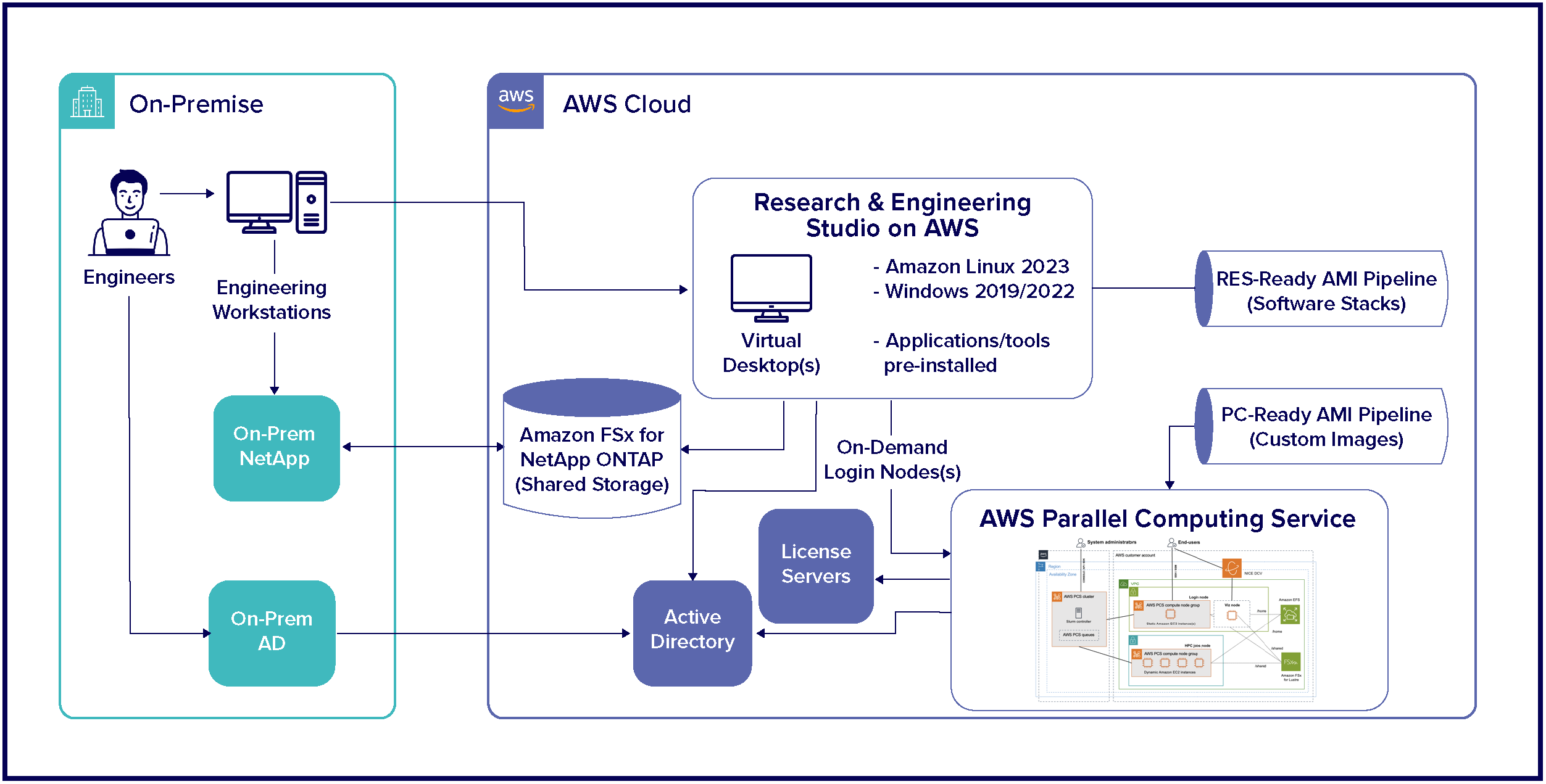
Key capabilities include:
- On-demand workspaces
Launch Windows or Linux engineering desktops in minutes - Secure, private deployment
Runs inside enterprise landing zones with private networking - Enterprise identity integration
Centralized authentication using existing directory services - High-performance shared storage
Designed for large simulation datasets and outputs - Infrastructure-as-code foundation
Enables repeatable deployments and future scaling - HPC-ready architecture
Built to evolve into burst and large-scale compute environments
Works Across AWS Commercial & GovCloud
A key differentiator of this solution is its ability to operate in both standard AWS regions and AWS GovCloud environments.
This allows organizations to:
- Meet regulatory and data sovereignty requirements
- Support restricted or sensitive research programs
- Maintain consistent tooling across regulated and commercial teams
- Apply the same operational model across regions
This flexibility makes the solution viable for compliance-driven Scientific Computing workloads without compromising innovation velocity.
Industry Use Cases
This blueprint directly supports Scientific Computing and Engineering Design workloads across multiple industries, enabling teams to scale securely while maintaining performance and compliance.
Space and Aeronautics
- Aerodynamics, CFD, and structural simulations
- Secure environments for sensitive and regulated programs
Semiconductor and EDA
- Chip design, verification, and simulation workloads
- Elastic scaling for compute-intensive design cycles
Pharma and Life Sciences
- Molecular modeling and simulation
- Secure and compliant research environments
Manufacturing and Industrial Engineering
- Digital twins and simulation-driven design
- Faster design iterations and improved collaboration
Pre-Built, Open Source, and Frictionless to Adopt
This solution is designed to accelerate adoption while reducing risk and operational effort.
Solution characteristics
- Pre-built, based on a proven reference architecture
- Open source, powered by AWS Research and Engineering Studio
- Enterprise-ready, aligned with landing zone, security, and compliance best practices
To accelerate time-to-value, the platform can be deployed through a jump-start program delivered jointly by:
- Relevance Lab
- AWS Partner teams
The jump-start approach provides:
- Rapid deployment
- Pre-validated configurations
- Knowledge transfer and enablement
- A clear path to production scale
Business Outcomes
Organizations adopting this approach typically see measurable improvements across both engineering productivity and operational efficiency.
Key outcomes include:
- Faster onboarding for engineering and research teams, reducing time to productivity
- Improved productivity for scientists and designers through consistent, ready-to-use environments
- Stronger security and compliance posture aligned with enterprise and regulatory requirements
- Elimination of workstation bottlenecks, reducing dependence on physical infrastructure
- A scalable foundation to support future HPC and AI workloads
Most importantly, teams can focus on science and design, rather than managing infrastructure.
A Repeatable Blueprint for Scientific Computing
The blueprint shows how Scientific Computing and Engineering Design workloads can be modernized using a cloud-native, open-source, and enterprise-ready approach—without introducing vendor lock-in or operational complexity.
It is designed to be reused across industries, regions, and compliance models, providing a consistent foundation for secure, scalable engineering and research platforms.
This blog is based on a real-world enterprise engagement and has been anonymized for broader applicability.