

The next challenge: using sensitive data with GenAI
Generative AI is changing how organizations discover insights, accelerate research and automate knowledge-intensive work. Researchers can summarize thousands of documents, explore scientific data and ask questions of complex information. Healthcare, life sciences, government and enterprise teams see similar opportunities—but their data often carries strict privacy, intellectual property and regulatory obligations.
Trusted Research Environments (TREs) were created to let authorized users work with sensitive data under controlled identity, network, compute and data-access policies. GenAI introduces a new layer of risk. Organizations must now govern not only who accesses data and where it is processed, but also which models see it, what enters prompts, which tools agents can invoke and where generated outputs can go.
Risks include sensitive information being sent to unapproved models, unauthorized retrieval across projects, prompt injection, excessive agent permissions, exposure through conversation logs and limited visibility into AI usage and cost. Simply deploying a private large language model does not address the full problem.
Introducing Research Gateway AI-TRE
Relevance Lab is extending the TRE concept to support secure and governed Generative AI adoption. Research Gateway AI-TRE brings sensitive data, approved AI models, knowledge services and intelligent agents together within a controlled environment. It extends the TRE security boundary to cover model access, prompts, retrieval, agent execution and AI-generated outputs.
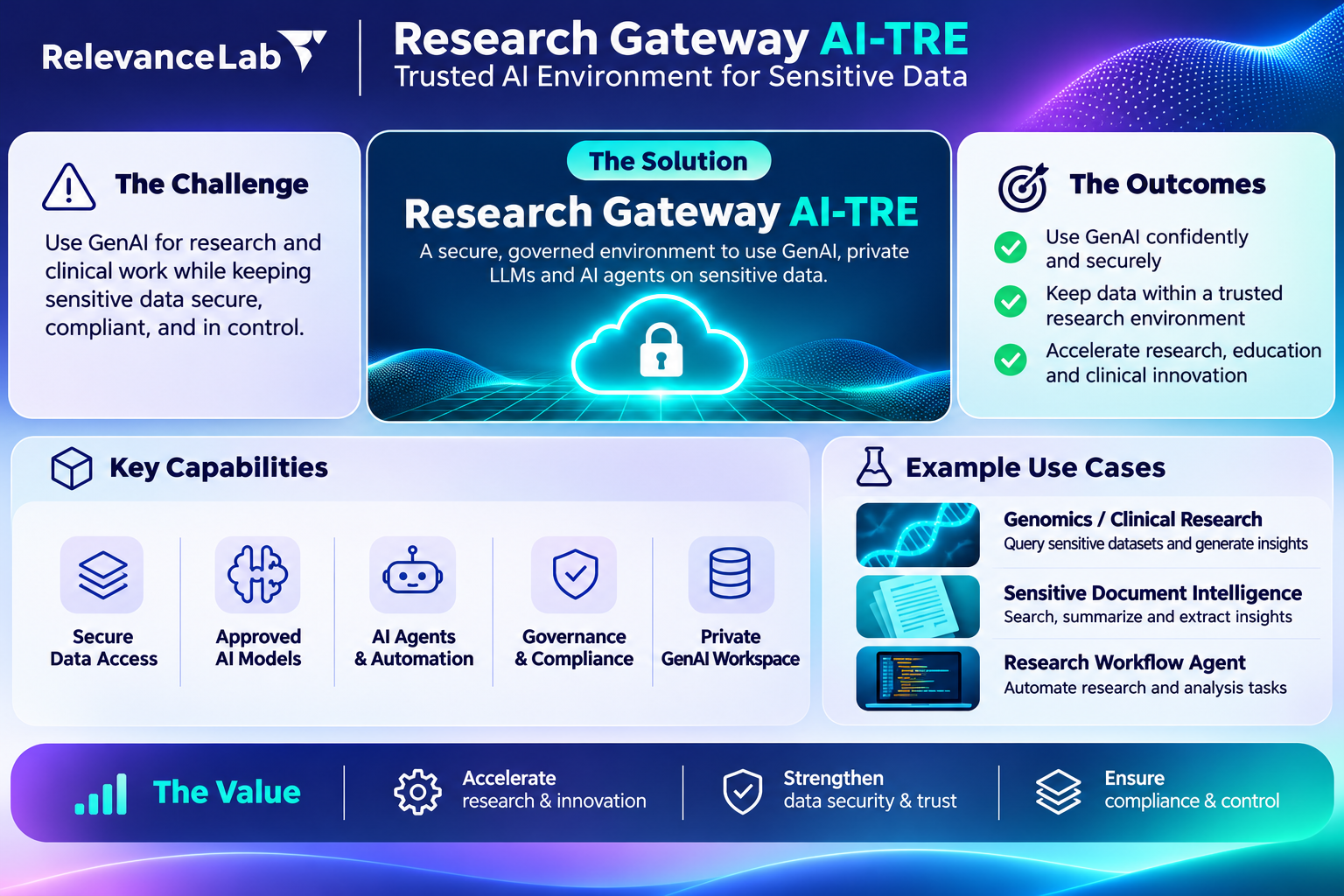
Five capabilities for a Trusted AI Environment
1. Private GenAI Workspace
Give researchers and authorized users a familiar AI chat experience inside the TRE. They can query approved models, summarize and compare sensitive documents, extract information and analyze data without relying on uncontrolled public AI applications.
2. Secure Data-to-AI Gateway
Connect approved project data repositories to permission-aware RAG and knowledge services. Enforce project and document-level authorization before information enters the model context; keep indexes and embeddings within the designated security boundary and provide source traceability.
3. Controlled AI Agent Runtime
Run pre-approved agents with their own identities and tightly scoped permissions. Restrict access to authorized datasets, APIs and tools; isolate execution; require human approval for sensitive actions or exports; and audit tool invocations.
4. AI Security, Governance and Audit
Apply model allowlisting, project-based policies, prompt and response inspection, prompt-injection defenses, network egress restrictions and auditable records of model use, retrieval and agent actions. Protect AI logs themselves with appropriate encryption, access and retention controls.
5. AI FinOps and Resource Management
Extend project-centric FinOps to token and model consumption, inference and GPU utilization, project or grant-level cost allocation, quotas and budget alerts—helping leaders understand both AI value and operating cost.
Built on the TRE foundation
AI-TRE builds on the security and governance foundation organizations already use to protect sensitive data. Research Gateway provides the user experience, while an AI control layer governs model access, knowledge retrieval, agent execution and policy enforcement. The protected environment can host project data, vector stores, isolated agent workloads and approved private models.
The architecture can integrate with cloud AI services such as AWS Bedrock using appropriately configured private connectivity and service-level controls, or support self-hosted models when inference must remain within customer-controlled infrastructure. A private connection to a managed model service does not necessarily mean inference executes inside the customer's VPC; provider, region and data-handling terms must be assessed. The platform direction can evolve across AWS, Microsoft Azure and Google Cloud.
Where it makes a difference
- Healthcare and academic medicine: assist authorized research teams with approved clinical documents and datasets.
- Life sciences and pharma: support scientific knowledge discovery, protocol analysis and controlled document workflows.
- Government and public research: enable AI-assisted analysis within environments designed for stringent security needs.
- Enterprise: work with confidential documents, source code and intellectual property without exposing them to uncontrolled AI services.
A practical path to adoption
Organizations can start with secure GenAI access and document analysis, then introduce permission-aware knowledge retrieval, controlled agents, and broader AI governance and optimization. This incremental approach delivers early value while strengthening controls as use cases mature.
From Trusted Data to Trusted Intelligence
The next phase of digital transformation will be defined by how effectively organizations turn valuable information into intelligence while preserving trust. Trusted Research Environments established the foundation for secure access to sensitive data. Trusted AI Environments extend that foundation to a world where models and intelligent agents increasingly interact with that data.
Research Gateway AI-TRE represents this next step: bringing GenAI to sensitive data, rather than forcing sensitive data into uncontrolled AI environments.
Explore Trusted AI with Relevance Lab
Evaluating how to introduce Generative AI into a secure research, healthcare, life sciences, government or enterprise environment? Connect with Relevance Lab to discuss Research Gateway AI-TRE and your secure GenAI adoption roadmap.